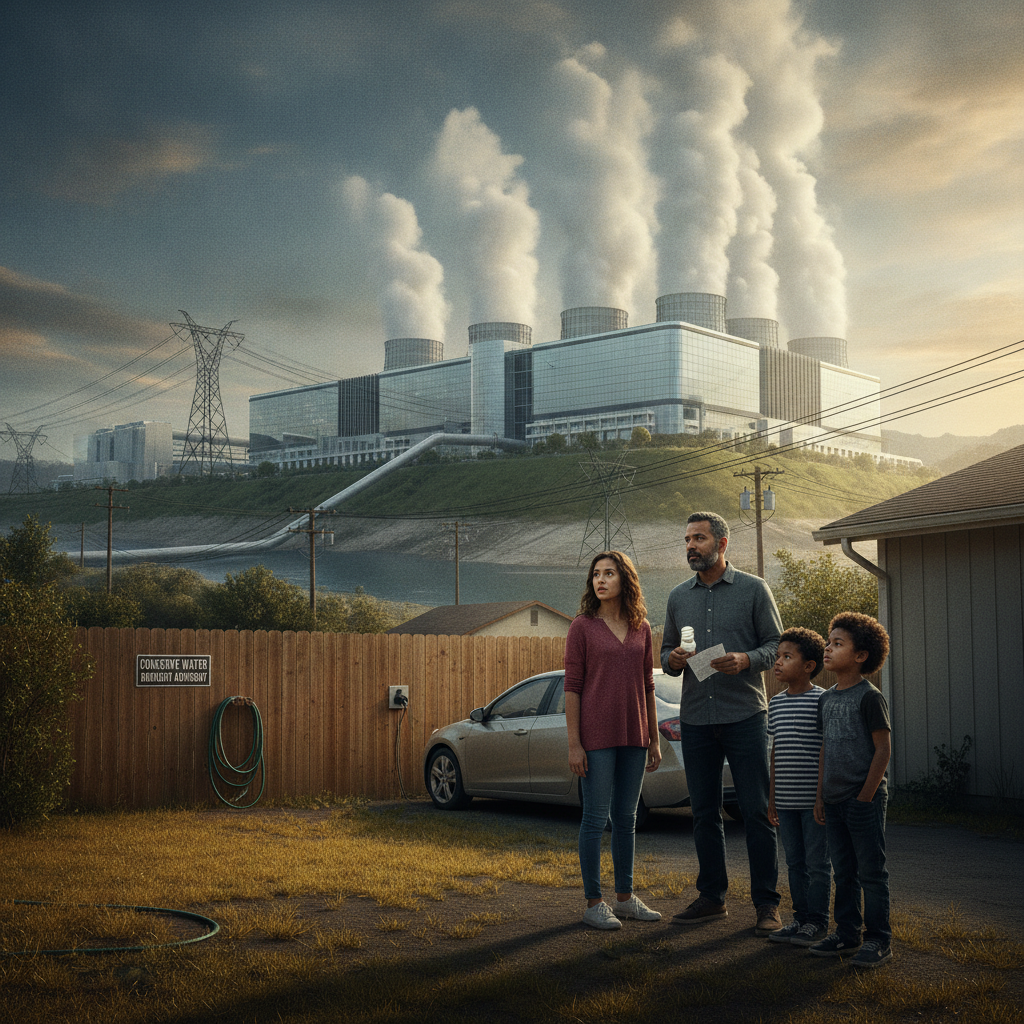
A family is told to take shorter showers, replace light bulbs, buy an electric vehicle, pay higher utility bills, reduce their carbon footprint, conserve water, and prepare for drought. Then they learn that millions of gallons of water and vast amounts of electricity are being allocated to a single industrial project nearby. The contradiction is not hard to see. If conservation matters for everyone, shouldn’t it matter for everyone?
That question sits at the center of a much larger debate about AI, data centers, energy, and the future of American communities. This is not an argument against technology. It is not an argument against business. It is an argument against an outdated model of growth that takes from communities faster than it gives back.
America needs AI. It needs data centers, modern manufacturing, stronger grids, better transmission, more generation, and smarter infrastructure policy. But the rules guiding that growth were built for a different era—one in which industrial development was slower, smaller, and easier to absorb. Today’s projects can reshape water systems, power demand, land use, tax policy, and public trust before a town has time to understand what it is being asked to host.
The Real Problem Is Not Growth
The debate around AI infrastructure is often framed as a choice between progress and resistance. That framing is too simple. The real issue is whether growth strengthens the place that makes it possible.
Communities across the country are already living with the consequences of aging electric grids, strained water systems, and mounting public skepticism. Add exploding demand from AI, automation, robotics, advanced manufacturing, and electrification, and the pressure becomes obvious. These are not abstract policy questions anymore. They are decisions about who gets power, who gets water, who pays, and who benefits.
That is why the old playbook no longer works. A project can be legal, profitable, and even well-intentioned, and still leave a town weaker than before. When that happens, the system is not merely inefficient. It is extractive.
A community should never be weaker because industry arrived.
That principle should be the baseline for every major industrial decision made in America from this point forward.
Community-First Industrial Development
If the country wants to build for the next decade instead of the last one, it needs a new framework: Community-First Industrial Development. The concept is simple. Private industry can build. Public infrastructure can grow. But the community hosting the project must come out stronger, not carrying the hidden burden.
Infrastructure Before Expansion
If a company needs more power, more water, and more transmission capacity, the system serving that demand should be expanded before the project comes online—not after the community has already absorbed the strain.
That means utilities, municipalities, and developers should be forced to answer a basic question: what new infrastructure is being built for this project, and how does it improve service for existing residents?
A project that depends on public infrastructure should not be allowed to consume that infrastructure as though it were infinite. If the demand is private, the investment should be real and proportionate.
Industry Pays Its Own Way
This is where public debate often gets distorted. Companies argue, sometimes honestly, that they bring jobs, tax revenue, and economic activity. That may be true. But it does not automatically justify shifting costs onto ratepayers, water customers, or local governments.
Private demand should require private investment. No hidden subsidies. No creative accounting. No quiet transfer of risk from the balance sheet of a corporation to the monthly bill of a family.
If a data center needs a new substation, that cost should not be disguised as a public obligation. If a facility requires additional water treatment or transmission upgrades, the public should know exactly who is paying and why.
Water Capacity Neutrality
The industry should move beyond the vague promise of being “water neutral.” That phrase sounds responsible, but it often leaves too much undefined.
A better standard is water capacity neutrality. If a project uses water, it should not reduce long-term resilience for the people already there. That means reclaimed water where feasible, recycling systems where practical, aquifer protection where necessary, and planning that recognizes drought is not a theory in many regions. It is a recurring reality.
This is not about stopping development. It is about refusing to pretend water is limitless.
Residents Come First
When shortages hit, priorities should be transparent and non-negotiable.
- Drinking water
- Hospitals
- Residents
- Agriculture
- Industrial computing
That hierarchy is not anti-business. It is pro-civilization. If a region cannot defend the needs of households and essential services before industrial computing, then it has not built a resilient system. It has built a fragile one.
Resource Ready Industrial Zones
Not every project belongs everywhere. America should build resource-ready industrial zones—purpose-built campuses with shared infrastructure, planned transmission, dedicated water systems, and clear environmental rules.
This is smarter than scattering massive projects across communities that were never designed to absorb them. It concentrates infrastructure where it can be planned, monitored, and expanded with real oversight. It also gives local governments a better chance to negotiate from a position of clarity instead of urgency.
A region should not have to reinvent its utility system every time a developer arrives with a pitch deck.
Community Infrastructure Dividend
If a project receives tax incentives, utility advantages, or public support, a portion of those benefits should flow back into the community automatically.
That can include:
- schools
- roads
- parks
- broadband
- utility assistance
- workforce development
- conservation projects
Call it a Community Infrastructure Dividend. The idea is straightforward: if a major project benefits from a community’s resources, that community should see visible, lasting improvements in return.
What if every major project visibly improved the community hosting it?
That is not charity. That is a fair exchange.
Performance-Based Incentives
Tax incentives should not be handed out as one-time promises. They should be earned annually.
If public support is justified, it should be tied to measurable performance: jobs created, wages paid, environmental compliance, local purchasing, infrastructure commitments, and transparency. If a project delivers, it continues to qualify. If it falls short, the support should shrink accordingly.
That approach does two things at once. It protects taxpayers, and it rewards operators who actually behave like long-term partners.
Full Transparency
No community should be asked to approve a project it cannot fully see.
Before approvals occur, residents deserve to know:
- how much water the project will use
- how much electricity it will demand
- what tax incentives are being offered
- what infrastructure will be required
- who will pay for upgrades
- what expansion plans already exist
Transparency is not a hurdle to good development. It is the foundation of legitimate development. A deal negotiated behind closed doors may be convenient. It is rarely durable.
Why This Conversation Is Bigger Than Virginia
These questions are not limited to one state, one county, or one corridor. Virginia may be one of the places where the pressure is most visible, but every state will face some version of this debate soon enough.
AI demand is not slowing down. Neither is automation. Robotics, advanced manufacturing, nuclear generation, renewables, natural gas, transmission buildout, and workforce shortages are colliding at the same time. That collision will force states to make hard choices about land, water, power, tax policy, and regional planning.
The answer is not to reject the future. It is to build one that can actually hold the weight of its own ambitions.
The next economy will not be judged only by how much it produces. It will be judged by whether it can support the people who live under it.
That is why the old arguments are no longer enough.
Environmental activists who oppose every project without offering workable alternatives are part of the problem. Corporations that expect public subsidies while externalizing risk are part of the problem. Politicians who cut deals behind closed doors and call it progress are part of the problem.
This is not a left issue or a right issue. It is a competence issue.
America can build AI infrastructure, modern industry, and a stronger energy system. It can do that without sacrificing the communities that power it. But only if it stops treating local residents as an obstacle to be managed and starts treating them as stakeholders whose strength is part of the asset.
The new social contract is not complicated. If a project consumes public resources, it must help build public resilience. If industry arrives, the community should not leave poorer, weaker, or less secure.
A community should never be weaker because industry arrived. That should be the standard. Anything less is not growth. It is extraction.