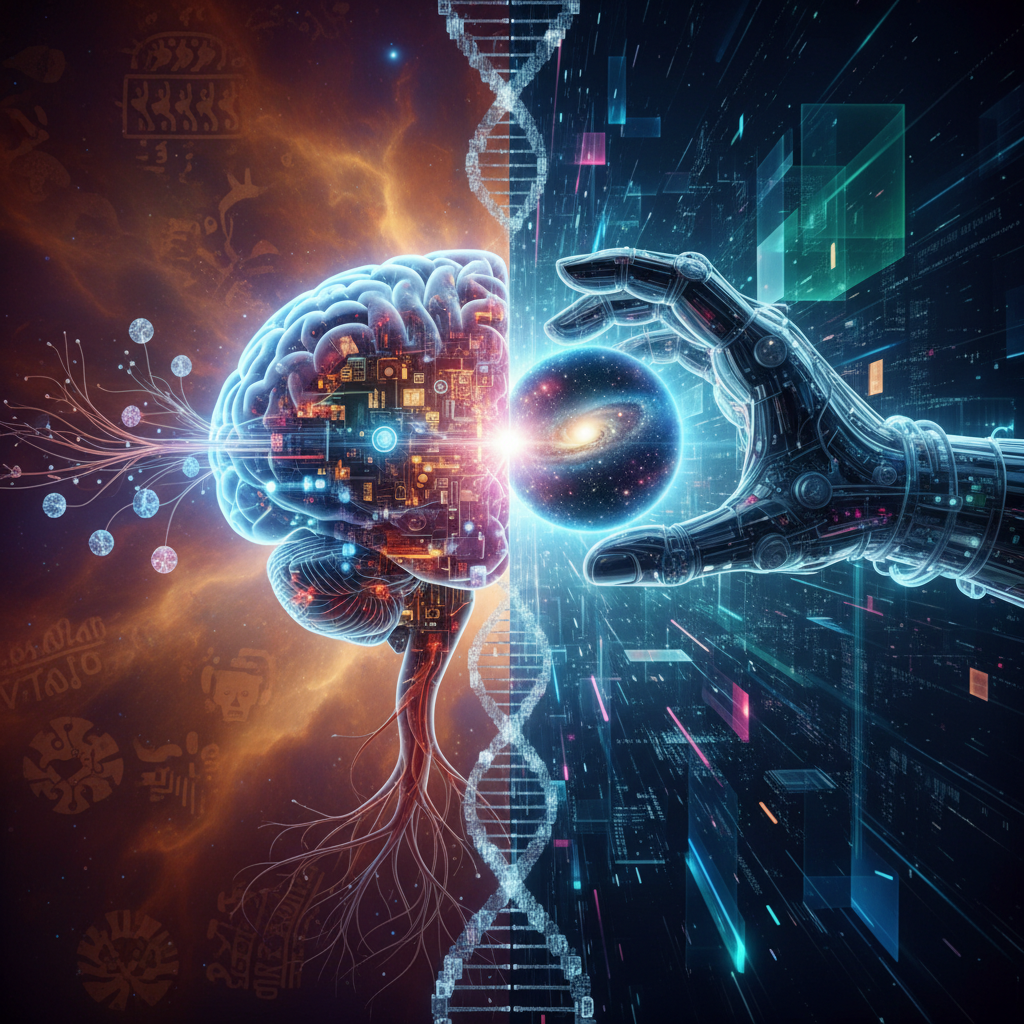
The discussion around human evolution has long moved beyond biology alone. In contemporary writing, it increasingly includes cognition, technology, ethics, and the possibility that evolution itself may be shaped by conscious choice. That is the frame explored in Jeffrey Robertson’s EndoDyne: When Evolution Becomes Conscious, a piece that invites readers to consider what happens when adaptation is no longer passive but deliberate.
From Biological Change To Conscious Design
For most of history, evolution was understood as a slow, impersonal process driven by natural selection. Traits persisted because they improved survival, not because organisms planned for the future. But modern life has complicated that view. Humans now shape their own environments, alter their bodies through medicine, and extend their capabilities through digital systems.
This shift has made evolution harder to describe in purely biological terms. Language, tools, education, and technology all influence what individuals and societies are able to become. The result is a broader interpretation of adaptation: not only the survival of the fittest, but the survival of the most responsive.
In that context, the idea of consciousness becomes central. If human beings can recognize the direction of change, they can also influence it. That does not mean evolution stops being natural. It means the line between natural process and intentional design is becoming increasingly difficult to draw.
Why The Idea Resonates Now
The appeal of a concept like EndoDyne lies in its timing. People are living through a period of rapid change in which biology, identity, and intelligence are being redefined in real time. Advances in biotechnology, artificial intelligence, and neurotechnology are forcing a new set of questions about what it means to improve, to adapt, and to remain human.
Rather than treating these questions as abstract, the conversation becomes practical. How much of human development is inherited, and how much is chosen? At what point does enhancement become transformation? And if consciousness can shape outcomes, who gets to decide the direction of that influence?
These are not speculative concerns confined to science fiction. They are already present in debates around healthcare, data, cognitive performance, and the ethics of emerging technologies. A framework that considers evolution as conscious rather than accidental gives readers a way to organize those debates without reducing them to simple optimism or fear.
Adaptation As A Human Skill
One of the most compelling aspects of this conversation is that adaptation itself can be seen as a skill. Humans do not merely react to conditions; they interpret them, learn from them, and build systems to respond more effectively in the future.
That has always been true in education, engineering, and medicine. What changes in the present era is the speed and scale at which adaptation occurs. Individuals are now expected to adjust to new tools, new norms, and new forms of intelligence with unprecedented frequency. Conscious evolution, in this sense, is not just a theory about biology. It is a description of modern survival.
A Framework For Responsibility
Any discussion of conscious evolution also raises a harder issue: responsibility. If human beings are increasingly capable of directing change, they inherit the obligation to do so carefully. Power without reflection can produce inequality, overreach, and unintended consequences.
That is why this subject cannot be separated from ethics. Technological progress does not automatically produce human progress. It can also amplify bias, concentrate control, and accelerate systems that are poorly understood. A serious examination of evolution as a conscious process should therefore include not only possibility, but restraint.
This is where thoughtful cultural analysis matters. By linking innovation to philosophy, writers like Robertson encourage a more disciplined approach to the future. Instead of treating transformation as an inevitable force, the discussion shifts to stewardship: what kind of future should be built, and by what values?
The Value Of The Question Itself
Even when a concept resists easy definition, it can still be useful if it sharpens attention. The strength of EndoDyne is not that it provides a final answer, but that it reframes an old question in a contemporary way. Evolution is no longer something people only inherit. In many areas of life, it is something they participate in.
That perspective has broad appeal because it sits at the intersection of science, identity, and imagination. It asks readers to consider whether consciousness is simply a byproduct of evolution, or whether it has become one of evolution’s active instruments. The answer may differ depending on the field of inquiry, but the question itself is significant.
For readers interested in the relationship between human development and intentional change, Jeffrey Robertson’s article on EndoDyne offers a starting point for further reflection. As technology and biology continue to converge, the idea that evolution may be becoming conscious feels less like a metaphor and more like a serious lens through which to view the future.
What follows from that recognition is not certainty, but responsibility. If the next stage of human development is shaped by awareness, then the most important task may be learning how to guide change without losing sight of what should remain human.