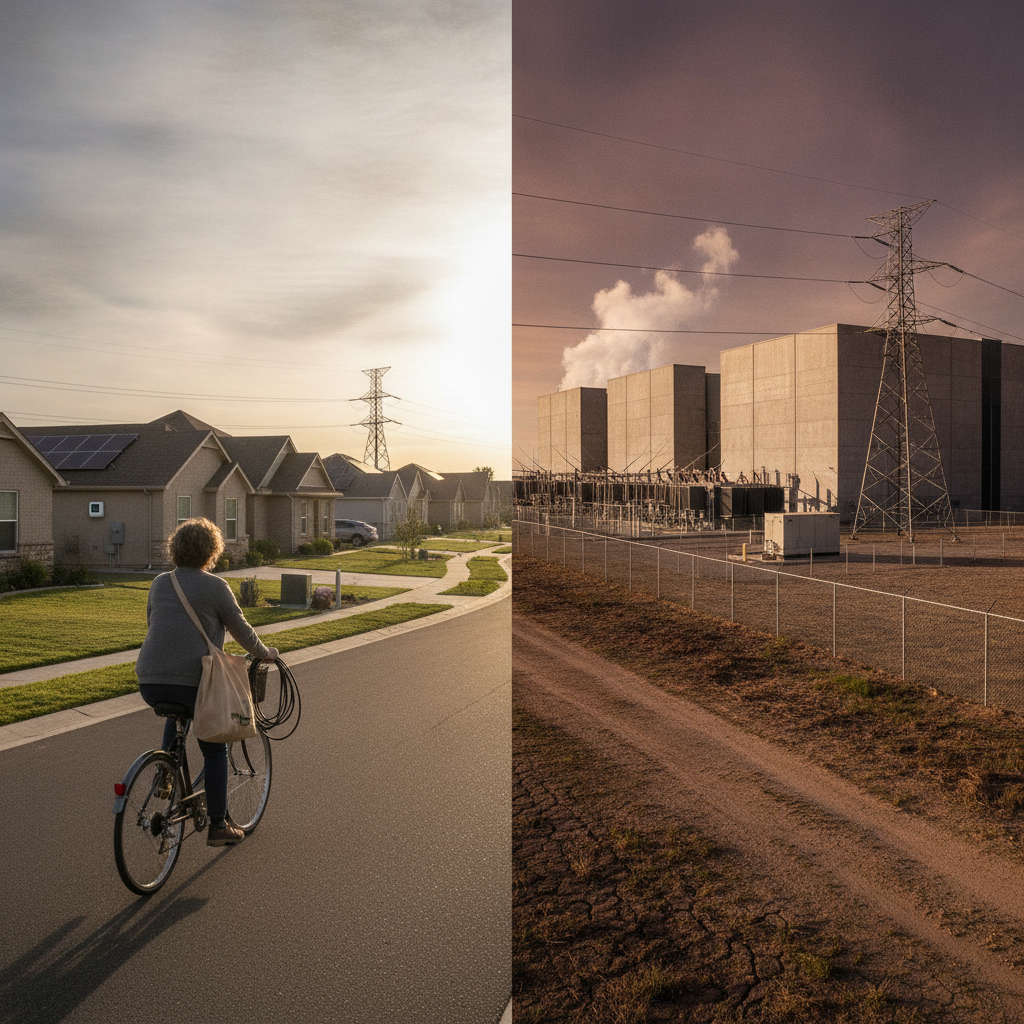
Virginia is being sold a simple climate story: drive less, buy an EV, install a smart thermostat, eat lower on the food chain, and brace for higher bills in the name of a cleaner future. That message is repeated so often it starts to feel like civic common sense. But in Northern Virginia, a far larger force is reshaping the energy conversation — one that does not ask politely for sacrifice, but arrives with megawatts, backup generators, massive cooling systems, and an appetite that makes household virtue look microscopic.
That is the central contradiction behind Virginia’s green hypocrisy. Ordinary residents are told their choices matter. Meanwhile, the state that brands itself as a climate leader is also home to the world’s densest concentration of data centers, and the growth story is still accelerating. The result is not just a tension between convenience and conscience. It is a collision between political messaging and physical reality.
The Scale Of The Boom
Virginia is not merely a player in the data center industry; it is the unquestioned capital of it. Northern Virginia, especially the Ashburn area of Loudoun County, has become the beating heart of global digital infrastructure. Hundreds of facilities are already operating across the state, with hundreds more proposed or in the pipeline. What began as a niche real-estate and telecom market has become a full-scale industrial buildout.
The reason is straightforward: every search, stream, cloud backup, AI query, and enterprise workflow runs through somewhere. And that “somewhere” increasingly sits on Virginia land, drawing power from Virginia utilities and expanding at a pace that far outstrips the way most people think about electricity demand. The latest projections suggest the state’s power needs could roughly double within about a decade, driven heavily by data center energy consumption.
That is not a small adjustment. It is a structural shock to the grid.
And electricity is only part of the story. These facilities consume vast amounts of water for cooling, create a persistent low-frequency noise footprint from equipment and generators, and transform once-quiet suburban and exurban landscapes into landscapes of concrete, fencing, transformer yards, and transmission lines. Residents who expected schools, homes, or open space often find themselves looking at windowless industrial boxes instead.
Then there is AI power demand Virginia can no longer politely ignore. Artificial intelligence is adding a new layer of intensity to an already voracious system. Training large models and serving real-time inference is not the same as hosting static cloud storage. The load is heavier, spikier, and more relentless. The state is effectively planning for a digital economy whose energy appetite is still increasing faster than its public discussion.
The Policy Contradiction
Virginia’s climate ambition is codified in the Virginia Clean Economy Act, which points the state toward carbon-free electricity by 2045. On paper, that is a sweeping commitment. In practice, it collides with a political culture that constantly asks residents to prove their environmental sincerity through personal restraint while the largest new industrial users of power are treated as the unavoidable cost of progress.
That contradiction is hard to miss. Households are encouraged to shift usage, electrify appliances, and accept rate increases in the name of decarbonization. Yet the same state must keep the lights on for a fast-growing cluster of facilities that can operate 24/7 and cannot simply “turn down” when wind or solar output dips. The grid does not care about slogans; it cares about instantaneous supply and demand.
That is why natural gas has become the uncomfortable bridge fuel in the short term. Even as Virginia tries to build more renewables, interconnect new resources, and modernize transmission, data center growth is pushing electricity demand so quickly that cleaner generation is struggling to keep pace. The cleaner the rhetoric, the rougher the operational reality.
This is where green energy hypocrisy becomes more than a phrase. It describes a political habit: asking individuals to internalize the sacrifice while large-scale industrial growth continues to expand the load. If the state genuinely believes emissions reduction is urgent, why does its messaging focus so heavily on habits at the margin while the biggest structural demand source remains protected by economic momentum?
Economics Versus Reality
To be fair, the data center boom is not imaginary wealth. It brings real tax revenue, construction activity, infrastructure investment, and some high-value technical jobs. Local governments in Northern Virginia have used data center revenues to fund services and keep property tax rates from rising even faster. Virginia has become a magnet for digital infrastructure precisely because it offers a strong business environment, proximity to federal agencies, and a mature network ecosystem.
But the costs are no less real.
Grid upgrades will be expensive, and there is a legitimate question about who pays. If transmission lines, substations, and generation capacity must be expanded to serve enormous new loads, regulators must decide whether ordinary ratepayers absorb part of that burden or whether the industry pays in full for the infrastructure it requires. That question is not technical trivia; it is a fairness issue.
Local communities are also bearing the friction. Residents worry about noise, traffic, industrial sprawl, water use, and the loss of neighborhood character. County governments face pressure to approve projects quickly because the tax base is attractive, even when the long-term quality-of-life effects are less appealing. And as the system grows more dependent on a concentrated set of power-hungry facilities, reliability risks increase if planning lags behind demand.
Virginia’s new electricity consumption tax on data centers is a belated acknowledgment that the old free-lunch model is over. It is a common-sense step in the right direction. But the question is whether it goes far enough, or whether it merely scratches the surface of the true infrastructure and environmental costs. If the facilities are driving major system-wide expansion, should they not be paying for the privilege in a much more direct way?
The Common-Sense Gap
If the public is told repeatedly that environmental responsibility requires sacrifice, then the largest new consumers should face the strictest standards first. That means full cost recovery for the infrastructure they require. It means the highest-efficiency cooling systems, where practical. It means stronger incentives for waste heat reuse. It means tougher siting rules that keep the heaviest industrial loads farther from homes and schools. It means transparent reporting on electricity use, water use, and backup generation.
It also means being honest about 24/7 power demand. A data center is not a rooftop solar panel or an electric car charger. It is an industrial customer with constant expectations and huge scale effects. Pretending otherwise invites cynicism.
That cynicism is already visible. People notice when they are urged to change their commute or their thermostat while a massive new data center campus is approved down the road. They notice when the language of virtue is applied to households but not to the corporate and utility decisions that shape the actual grid. They notice, and they start to distrust the entire environmental project.
A serious policy framework would not demonize data centers. It would simply stop giving them a pass.
The Broader Implications
Virginia’s dilemma is national in miniature. AI and cloud computing are essential to modern life, and no serious person argues for turning back the clock. But essential does not mean consequence-free. We cannot build an AI-driven economy on the fiction that its energy demands are invisible or that its carbon footprint can be wished away by asking families to recycle more carefully.
Responsible policy would start with pragmatic energy planning. That includes faster deployment of firm clean power, including nuclear energy and potentially advanced reactors or SMRs where they make sense. It includes serious transmission investment, not as a press release but as a long-term public works commitment. It includes a realistic view of renewables, which are valuable but not yet sufficient on their own to support round-the-clock industrial growth at this scale.
Most of all, it requires honesty about trade-offs. If the state wants the economic upside of digital infrastructure, it must also accept the grid, land-use, water, and emissions consequences that come with it. If it wants cleaner power, it must build the supply to match the load. If it wants public trust, it must stop lecturing the smallest actors while excusing the biggest.
The coming era of AI power demand Virginia is only beginning to confront will test whether leaders can tell the truth before the grid tells it for them. That is the real choice: not climate virtue versus economic growth, but honesty versus performance. Virginia should choose the former before its green messaging becomes impossible to believe.