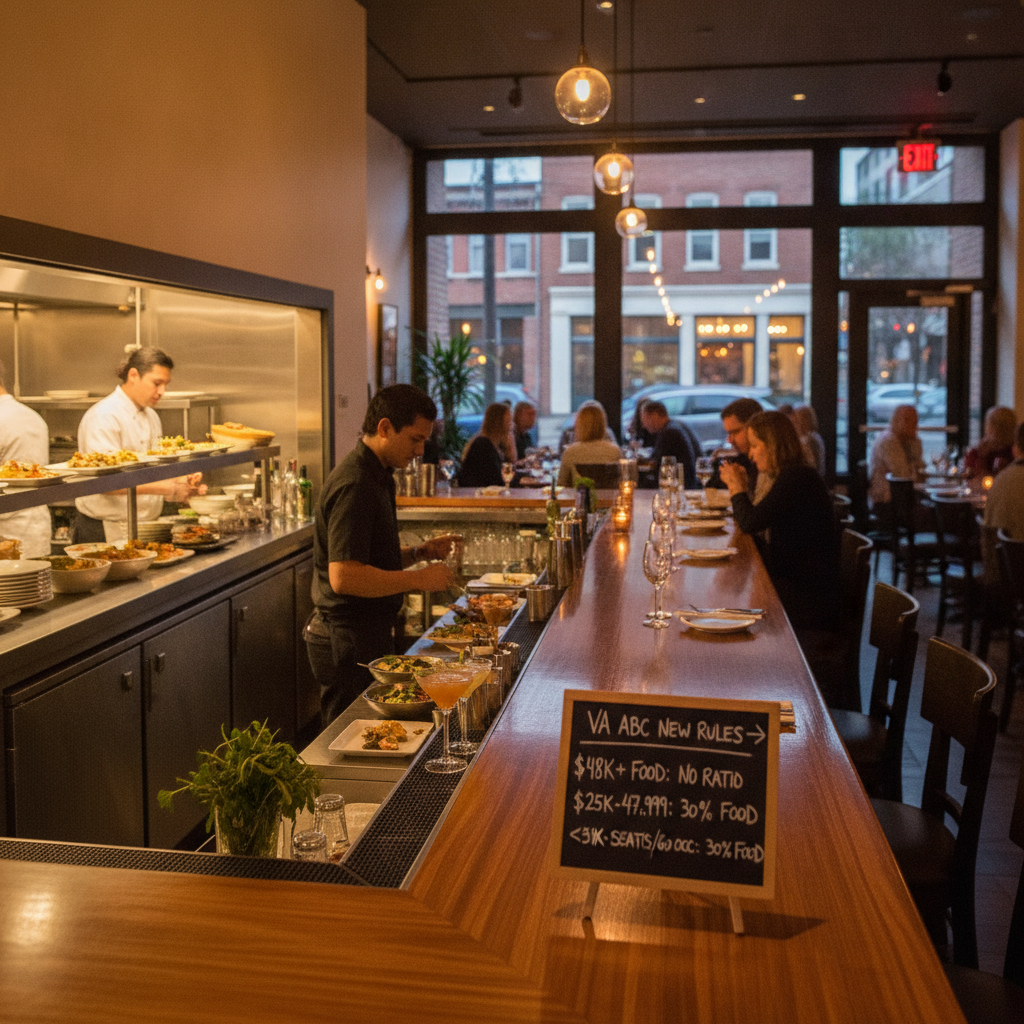
Virginia has changed how some restaurants qualify to sell liquor-based mixed drinks under a Virginia restaurant ABC license. For many operators, the new rules may create more room to grow beverage revenue. But the change does not turn Virginia into a state where anyone can open a pure stand-alone bar without a real restaurant operation.
For restaurant owners, developers, and entrepreneurs, the message is simple: the new Virginia food-to-liquor sales ratio rules can help, but they do not remove the need for careful planning around food sales, occupancy, seating, kitchen setup, licensing, and lease terms.
What Virginia Changed
The updated Virginia food-to-liquor sales ratio rules took effect on July 1, 2026. Before that date, most mixed-beverage restaurants had to maintain a 45% food and nonalcoholic beverage sales ratio.
Under the new framework, some restaurants can now qualify for more flexible treatment based on monthly food sales:
|
Average Monthly Food Sales |
General Rule |
|---|---|
|
$48,000 or more |
No food-to-liquor ratio requirement |
|
$25,000 to $47,999 |
At least 30% food ratio |
|
$4,000 to $24,999 |
Generally still subject to 45% requirement |
|
Fewer than 30 seats and occupancy below 60 |
Some smaller establishments may qualify for the 30% ratio |
This is a meaningful shift for businesses with stronger food volume. But the rule still depends on the facts of the business and the license type involved. It is not a blanket permission to run a bar first and a restaurant second.
What the Percentages Mean in Real Dollars
The percentages are not abstract. They affect how much of a restaurant’s monthly sales must come from food compared with liquor-based mixed drinks.
Example 1: Restaurant averaging $50,000 in monthly food sales
A restaurant at this level may fall into the tier with no food-to-liquor ratio requirement. That means the business may have more freedom to generate mixed-drink revenue, but it still must meet Virginia ABC and local requirements.
Example 2: Restaurant averaging $30,000 in monthly food sales
A restaurant in this tier must generally keep food at 30% of the total ratio. If the business expects $30,000 in food sales, it may be able to support more beverage sales, but the operator still needs to track the numbers carefully.
Example 3: Restaurant averaging $20,000 in monthly food sales
This business generally remains under the older 45% requirement. In practical terms, that means the operator cannot rely on heavy liquor sales alone. The restaurant must still produce enough food and nonalcoholic beverage revenue to stay compliant.
Beer and wine do not count the same way as liquor-based mixed drinks in the ratio calculation. That means the business model needs to separate those revenue streams clearly when planning monthly sales.
Who Benefits the Most
The biggest winners are likely to be restaurants that already generate strong food traffic and want to grow cocktail revenue. That includes:
- Upscale casual restaurants
- High-volume dining rooms
- Restaurant concepts in entertainment districts
- Adaptive reuse projects with enough space for a full food operation
- Operators who can consistently produce strong monthly food sales
This also may help entrepreneurs in downtown districts where a restaurant can anchor evening activity while still serving food as a core part of the concept.
Who May Receive Little or No Benefit
Some businesses may see limited value from the change. That includes:
- Small concepts with low food sales
- Businesses that want to operate mostly as a bar
- Locations without enough kitchen space for real food service
- Sites with limited seating or restrictive occupancy limits
- Operators whose lease or zoning plan does not support a restaurant use
If projected food sales are low, the business may still struggle to qualify for the more flexible tiers.
Why This Does Not Fully Legalize Stand-Alone Bars
This is the most important point for many new entrepreneurs: Virginia has not fully legalized traditional stand-alone bars.
A business still needs a legitimate restaurant operation, not just a drink menu and a few snacks. Virginia ABC food requirements, kitchen expectations, seating, occupancy, and recordkeeping still matter. The state is loosening some revenue rules for restaurants, not erasing the line between a restaurant and a bar.
A person thinking about opening a cocktail bar in Virginia should not assume the new rules create a shortcut around licensing. The concept must still function as a restaurant under the applicable rules.
Why This Matters for Small Cities and Property Owners
The new structure may create real opportunity for small cities, downtown development organizations, and commercial property owners. A stronger cocktail program can improve restaurant cash flow, which may help fill vacant storefronts and support older buildings that are being adapted for food service.
For adaptive reuse properties, this may improve the economics of a larger restaurant concept that can support both dining and mixed drinks. In a downtown district, that can mean more evening activity, more foot traffic, and more reason for adjacent businesses to stay open longer.
Even so, the location still has to work on paper and in practice. A promising concept will not succeed if the building cannot support the required use, the kitchen is too small, or the occupancy plan is weak.
Risks Entrepreneurs Should Understand Before Signing a Lease
Before signing a lease, business owners should answer these questions clearly:
- What are the projected monthly food sales?
- What is the building’s legal occupancy?
- How many seats will the establishment have?
- How many seats will sit at tables versus counters or bars?
- What type of kitchen and food preparation will Virginia ABC require?
- What percentage of revenue will come from food, beer, wine, and mixed drinks?
- Will the location qualify for the more flexible small-establishment rule?
- Can the concept survive if food sales fall below projections?
- Does the lease allow the intended restaurant and alcohol use?
- What permits, inspections, and local approvals will the business need?
These questions are central to restaurant business planning Virginia entrepreneurs cannot afford to skip. A concept that looks profitable on a spreadsheet may fail if the site cannot support the required operations.
How an SBDC Advisor Can Help
An SBDC advisor can help an owner test the business model before money is committed. That includes reviewing sales assumptions, comparing rent to projected revenue, and stress-testing whether the concept can still work if food sales are lower than expected.
SBDC support can also help entrepreneurs think through location selection, lease language, startup budgeting, and licensing readiness. For a Virginia restaurant startup, that kind of early planning can reduce expensive surprises later.
A good advisor will not replace legal, zoning, or licensing review, but can help identify where those issues may appear before the business is too far along.
Virginia’s new food-to-liquor sales ratio rules give some restaurants more room to grow, but they do not remove the need for disciplined planning. Owners should look closely at sales projections, seating, occupancy, kitchen requirements, and lease terms before treating the new rules as a green light. The businesses most likely to benefit are the ones that already operate as real restaurants and can prove it with numbers, space, and consistent food service.
Disclaimer: Requirements may vary depending on the specific business, location, occupancy permit, license type, and current Virginia ABC guidance. Businesses should confirm the latest rules with qualified professionals and the applicable authorities before opening or expanding.