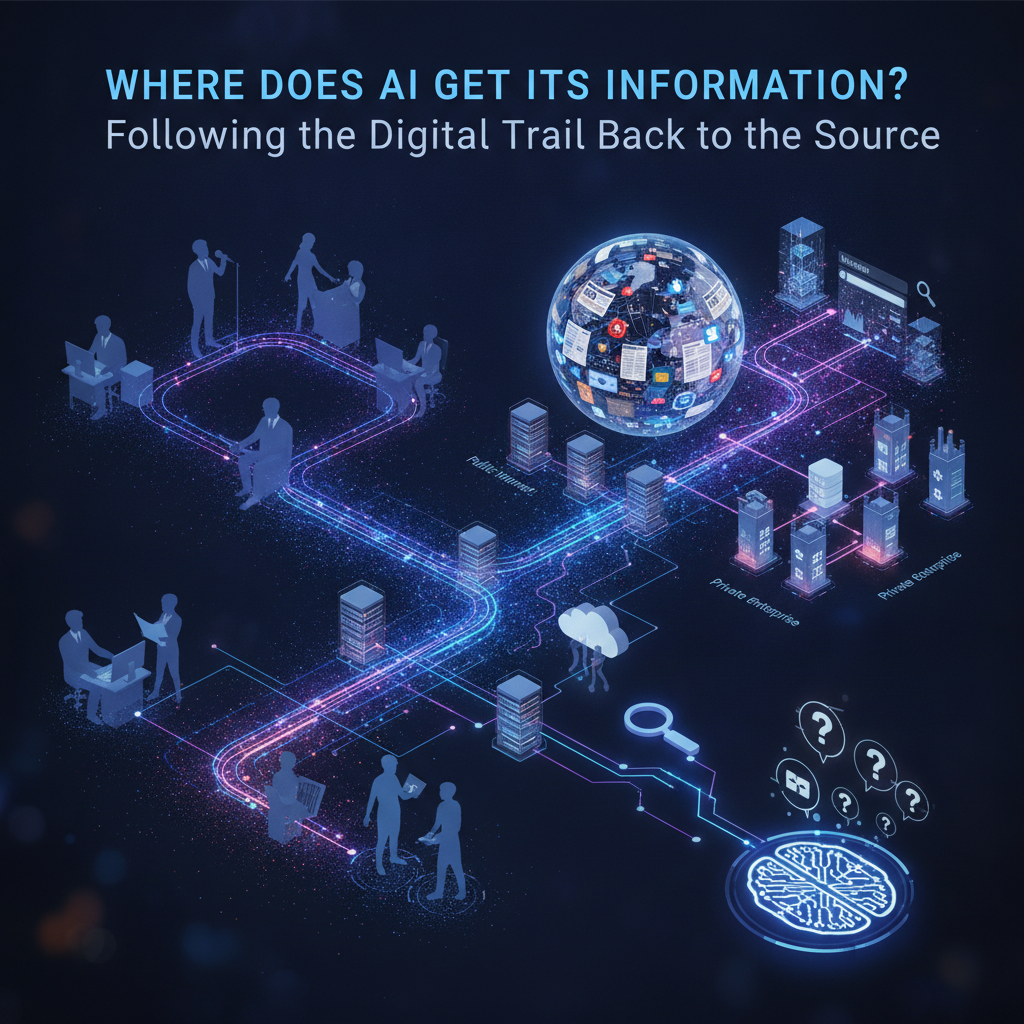
When a person asks an AI a question, the answer can feel instant, confident, and complete. But that response does not come from a single secret vault of knowledge. It comes from a long trail of human-made information, gathered, learned from, and sometimes connected to live data sources.
The Journey Starts With People
If someone asked, “Where does AI get its information?” the first answer is simple: from humans. Scientists write papers. Journalists report events. Teachers explain ideas. Businesses track customers, inventory, and sales. Governments publish records. Universities share research. Police write reports. Hospitals store medical records. Banks record transactions. Sensors on trucks, factories, satellites, and security cameras capture facts about the physical world.
Everyday people add to that stream too. Social media posts, reviews, photos, videos, and comments all create digital traces. In other words, humans create nearly all digital knowledge. AI does not invent that base layer of information. It learns from what people have already written, recorded, measured, or shared.
That is why the question “Where does AI get its information” matters so much. The answer begins with people, not with machines.
The Internet Is Not One Library
Many people imagine the internet as one giant library with every fact on every shelf. It does not work that way. Search engines crawl public websites, read what they can, and organize those pages in large indexes. When someone types a question into a search engine, it looks through that index and returns pages it believes match the query.
But the web only covers part of human knowledge. Public pages sit beside private systems, protected databases, and internal tools that search engines cannot see. A hospital’s internal records do not show up on Google. A bank’s transaction logs do not sit on public websites. A company’s maintenance history, customer service notes, and pricing records usually stay inside the organization.
That means much of the world’s knowledge never appears in public search results. The internet gives the impression of total access, but it only reveals a slice of the full picture.
The Hidden Internet Inside Organizations
The most valuable information often lives inside companies and institutions. This hidden layer includes customer records, emails, service histories, inventory systems, maintenance logs, manufacturing data, legal documents, police evidence, and hospital systems. These records often matter more than public web pages because they describe what a business actually knows, does, and needs.
A trailer dealership, for example, may learn more from its own sales history, repair notes, and warranty claims than from any public website. A hospital may improve care by connecting patient records, staffing data, and equipment logs. A manufacturing plant may reduce downtime by analyzing machine sensors and maintenance reports. A bank may detect fraud by studying transaction patterns inside its own systems. Law enforcement and emergency management agencies often rely on internal records that never enter the public internet at all.
This is why enterprise knowledge has become so valuable. Public data can teach broad patterns. Private data can reveal specific, practical truth.
How AI Learns
AI training sounds mysterious, but the basic idea is easier than many people think. Imagine reading billions of books, articles, reports, and records without memorizing each page word for word. Instead, you begin to notice patterns: which words usually appear together, how ideas connect, how questions usually get answered, and how language changes depending on the topic.
That is close to how AI learns. It studies large amounts of text, images, or other data and learns patterns rather than storing a perfect copy of every source. This is why AI can write, summarize, translate, and answer questions in ways that feel human.
It is also why AI sometimes gets things wrong. It can mix up details, rely on outdated patterns, or generate a response that sounds right but is not actually right. In AI, those errors often get called hallucinations. The system produces an answer that fits the pattern of language, even when the facts do not line up.
Fresh information often needs a direct connection to outside data sources. That is why many systems now connect AI to search tools, company databases, documents, or live feeds. Without that connection, an AI may rely on what it learned earlier, even if the world has changed.
Can AI Be Wrong? Yes
AI can be wrong for many reasons. It may learn from biased information. It may pick up outdated facts. It may absorb incorrect claims from unreliable sources. It may see contradictory information and choose the wrong pattern. It may encounter misinformation. It may also confuse fiction with fact if the language around both looks similar enough.
That does not mean AI is useless. It means AI needs oversight. A responsible user checks important claims against reliable sources, especially when the stakes are high. Medical advice, legal issues, financial decisions, emergency planning, and historical claims all deserve verification.
AI works best when people treat it as a tool, not an authority. It can help users find ideas faster, but it should not replace judgment.
Can History Become Distorted?
History has always passed through filters. Politics shapes what gets emphasized. Propaganda can bend events toward a message. National interests can influence how countries tell their own stories. Media outlets choose which facts to highlight. Schools decide which material to teach. Popular culture turns events into entertainment.
Movies, novels, documentaries, and social media often blend fact with interpretation. That does not make them worthless, but it does make them different from primary historical evidence. A film about a war is not the same as a battlefield report. A novel about a revolution is not the same as a government archive. A viral clip is not the same as a complete record.
AI can reflect those same distortions if its training data includes them. That is why readers should compare multiple sources instead of relying on one book, one website, one film, or one AI response. The strongest picture usually comes from many angles, not one voice.
The Companies Building AI and the Rise of Private Data
AI does not appear on its own. Model builders create the core systems. Search companies connect those systems to the web. Data providers supply licensed or structured information. Cloud providers offer the computing power. Enterprise software companies bring AI into workplaces, hospitals, factories, and agencies.
These groups work together because no single company owns all the information or all the tools. One company may build the model. Another may host it. Another may manage private documents. Another may handle security or workflow. The modern AI stack depends on partnerships as much as it depends on code.
That system explains why private data has become the new gold. Businesses increasingly care less about generic internet information and more about their own records. Their data tells them what they sell, what breaks, what customers need, where delays happen, and where money is lost or gained.
For a trailer dealership, that might mean pairing service records with sales patterns. For manufacturing, it might mean combining sensor readings with production schedules. For hospitals, it may mean using internal systems to support faster, safer care. For banks, it may mean spotting unusual transactions sooner. For law enforcement and emergency management, it may mean linking reports, maps, evidence, and alerts so teams can act faster.
When AI works with this kind of data, it becomes a competitive advantage. It stops being a general chatbot and starts becoming a decision tool.
The Future Is Closer to the Data
The next phase of AI will likely move closer to where information lives. That includes local AI, private AI, secure enterprise AI, edge computing, AI appliances, and AI systems built directly into organizations.
Why? Because many companies do not want to send sensitive records far away just to get an answer. They want AI to work near their own data, inside their own security rules, and within their own systems. A hospital may want AI beside patient records. A factory may want AI beside machine sensors. A city may want AI beside traffic systems and emergency dispatch tools.
This shift matters because it changes who controls information and how fast it moves. The closer AI gets to the source, the more useful it can become. The farther it sits from the source, the more it depends on old, broad, or incomplete data.
That brings the question back to where it started. When someone asks an AI a question, the answer may come from public web pages, private databases, training data, connected tools, or a mix of all four. The real story is not that AI has all the world’s knowledge in one place. The real story is that it follows the trail people leave behind.
If information is the world’s most valuable resource, who owns yours, who controls it, and who benefits from it?
The most informed users will not just ask AI questions. They will ask where the answer came from, what data shaped it, and whether the source deserves trust.